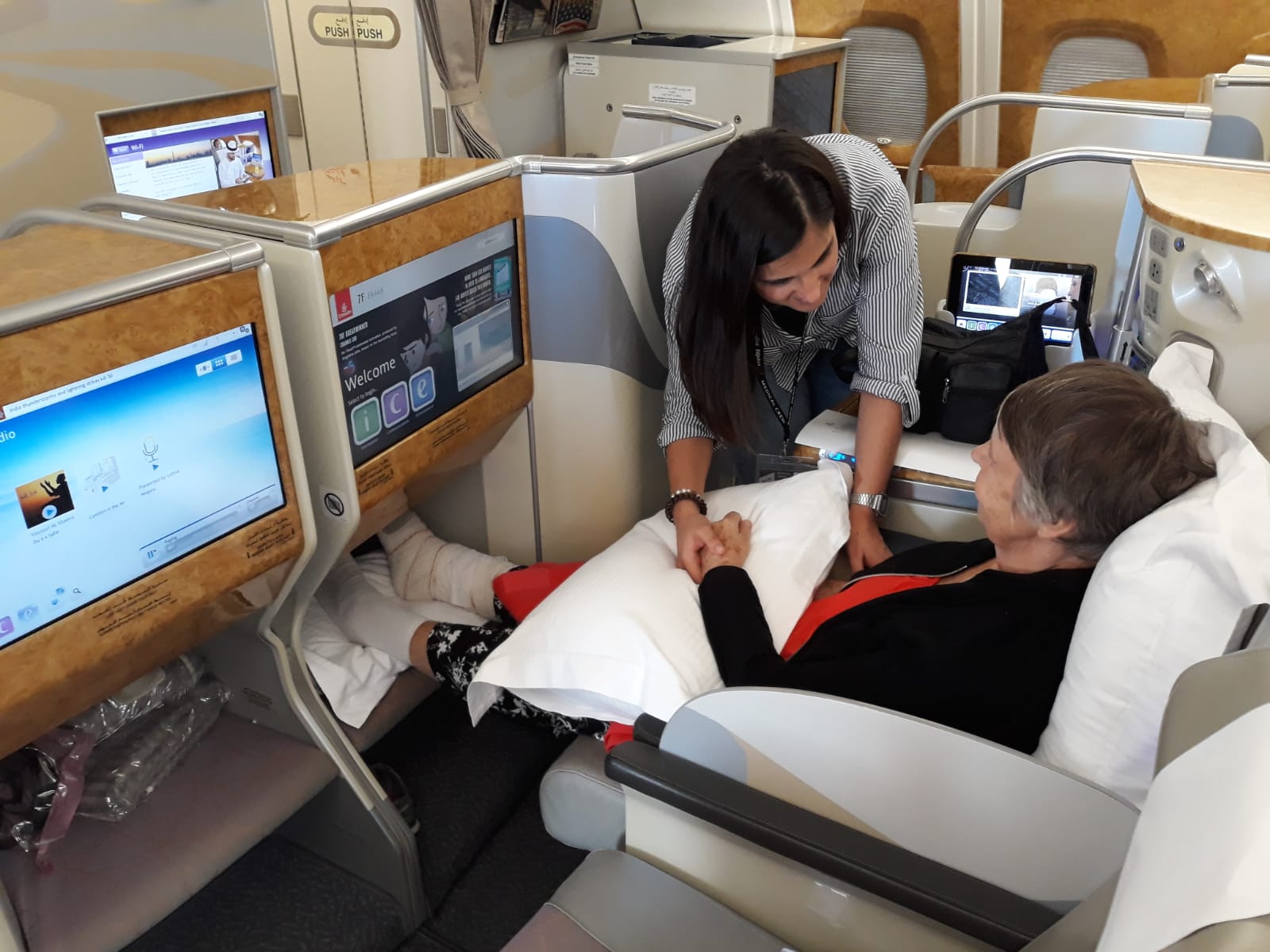
Commercial airline
For all patients who are medically stable. Particularly suitable for distances exceeding 1,500 km. Transfer can be arranged in a standard seat, a seat with extra room, or on a stretcher.
- Standard seat — the patient must be sufficiently independent to eat, move short distances and use the toilet, and must not disturb other passengers, per IATA regulations.
- Extra legroom / extra seat — for patients with affected lower limbs who need to keep their legs elevated, or who cannot bend for flights over two hours. The patient must still be able to support their feet on the cabin floor for take-off and landing.
- Stretcher — for patients who must travel lying flat. Allows long-distance travel at lower cost than a medical aircraft, with more flight options, though on-board medical equipment and lead time are more limited.
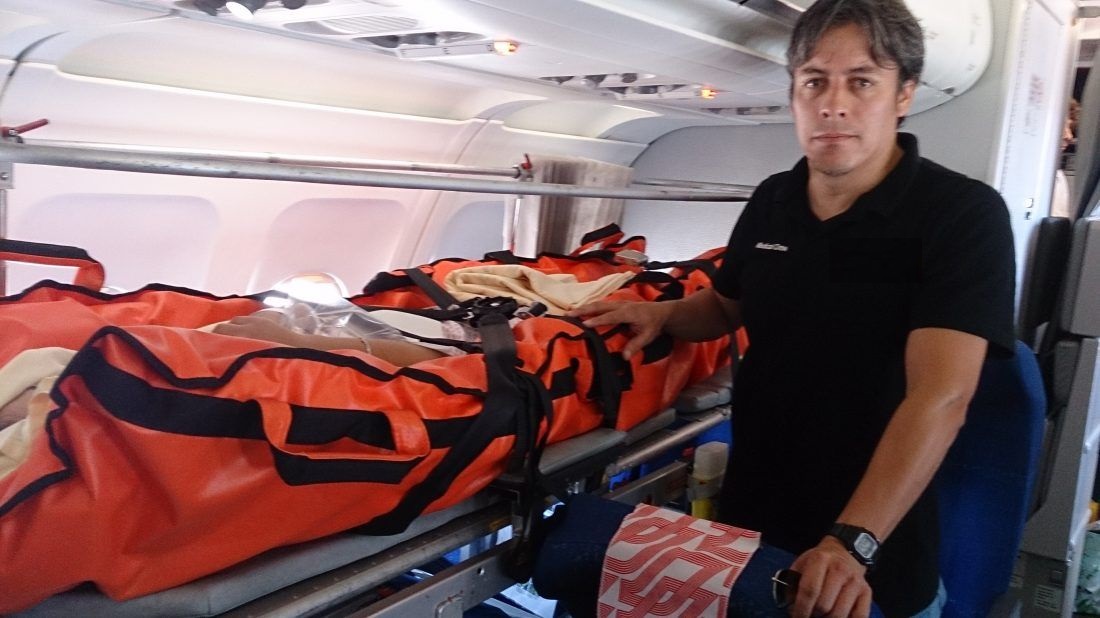
Air ambulance (ICU-equipped)
The treatment area of these aircraft is equipped as an intensive care unit, for patients susceptible to complications during transfer or who need extra care and attention.
- Used when a patient needs to travel lying down and no suitable commercial airline route is available.
- Especially suitable when the distance between hospitals exceeds 300 kilometres.
- Full medical crew and equipment on board for the entire route.
Land transport
Depending on the patient's needs, we offer transport by regular ambulance, train, minivan or car — always accompanied by staff with medical training.
- Saloon or minivan — for patients with minor upper- or lower-limb injuries (excluding the hip) who retain some autonomy, and who prefer the comfort and stability of this type of vehicle.
- Ambulance — for unstable, critical or potentially critical patients, and those who need to remain lying down.
- Train — increasingly viable thanks to high-speed rail services, for stable patients over medium distances.